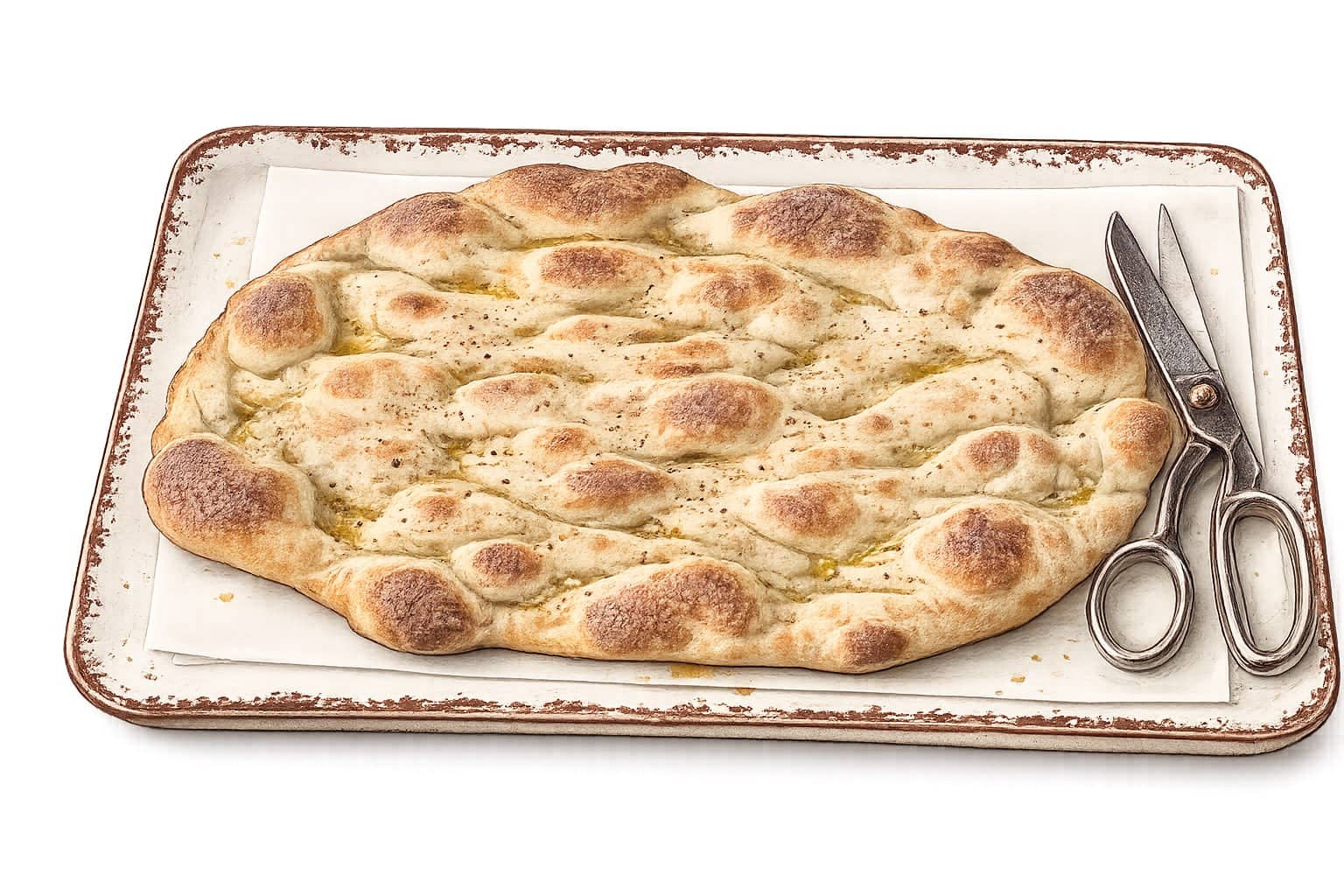
Pinsa is Rome’s lighter, crisper flatbread — and the story behind it is more interesting than the legend usually told about it. Here’s what pinsa actually is, where it really comes from, and why three days of waiting changes everything about how it eats.
If you’ve eaten pinsa and found yourself surprised that you didn’t feel weighed down afterward, you’ve noticed the thing worth understanding. Pinsa looks like a relative of pizza — an oval, blistered, golden base under a few good toppings — but the dough underneath follows entirely different rules.
Three flours instead of one. Eighty-five percent water instead of sixty. Seventy-two hours instead of overnight. Each of those choices does something specific, and together they produce a bread that behaves differently in the oven and afterward.
3
Flours in the blend
85%
Hydration
72 hrs
Cold fermentation
4
Ingredients, total
Where pinsa really comes from
There’s a story you’ll find on nearly every page written about pinsa: that Roman legionaries carried a flatbread of millet, barley and spelt, cooked on their shields over open fire, and that pinsa is that two-thousand-year-old recipe revived.
It’s a good story. The honest version is better, and it comes in two halves — both true.
The ancient half
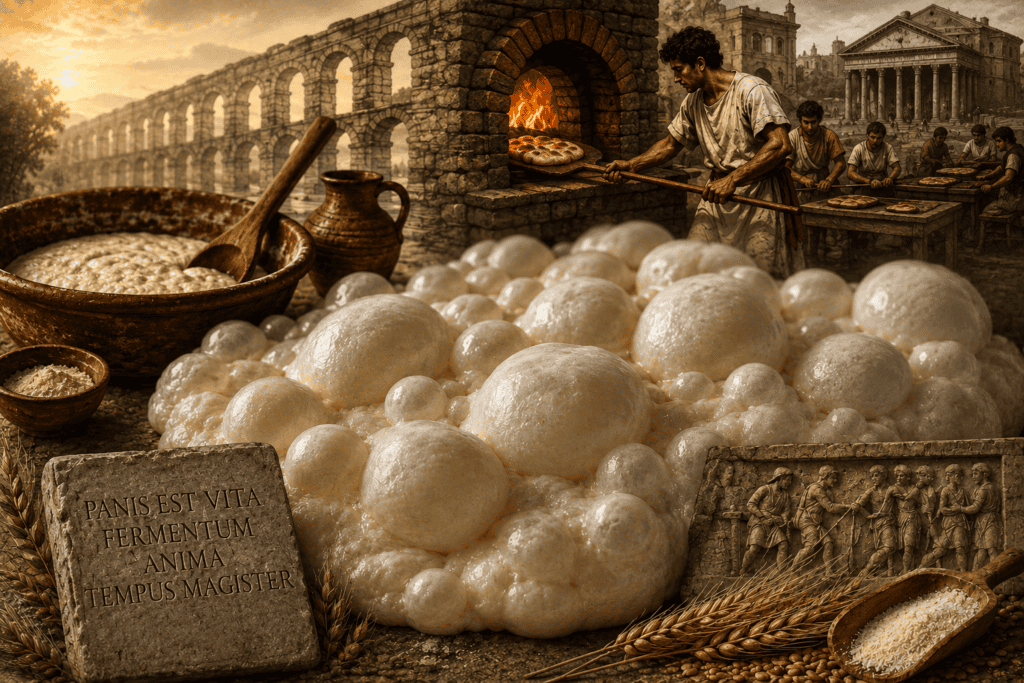
Grain wasn’t a background industry in Rome; it was the foundation of the entire civilization. At its peak the city held roughly a million people, far more than local farmland could feed, and it survived on wheat shipped in from Egypt, North Africa, Sicily and Sardinia — the breadbasket provinces.
Managing that was one of the ancient world’s great logistical achievements: the Annona, run by an official called the Praefectus Annonae, which procured grain from the provinces, moved it across the Mediterranean, landed it at the port of Ostia, barged it up the Tiber, stored it in vast public granaries and distributed it to hundreds of thousands of citizens. When it failed, Rome rioted. Whoever guaranteed bread held power — which is where panem et circenses comes from.
Ordinary Romans ate that grain as loaves from communal ovens, as a porridge called puls, and as simple flatbreads — portable, practical food for farmers, soldiers and builders, baked on hot stones. Those flatbreads were rarely made from a single refined flour. They were made from whatever mix of grains was at hand.
And the name is genuinely Latin. Pinsa comes from pinsere — to press, to stretch by hand. It describes a technique, not a recipe, and it’s the same technique our bakers use every morning: pressed outward with the fingers, never rolled.
The modern half
Pinsa romana as it exists today — the specific blend, the hydration, the fermentation schedule — was developed in Rome in the early 2000s by Corrado Di Marco, after years of experimentation with flours and leavening.
Di Marco’s own company has been unusually candid about this. In an article titled “History of Pinsa: between myth and legend, we reveal the truth,” they explain that they “experimented with a real storytelling around the origins of the pinsa” to give a new product resonance, and state plainly that the recipe “is the result of an intuition of the Di Marco family and is very different from what the Etruscans or ancient Romans presumably cooked.”
An ancient system, honored by a modern craft. Both halves of that story are true — and the truth is better than any legend.
So: the tradition of mixed-grain Roman flatbread is real and old. The precise recipe is young, deliberate and Roman. We think that’s a more interesting thing to be than a costume.
In May 2025 that story earned a footnote worth having. The Lazio region added pinsa romana to its official register of Traditional Agri-Food Products, the PAT list kept by ARSIAL, the regional agricultural authority. A recipe invented in 2001 is now, formally, a traditional food of the region that invented it. Twenty-four years is not two thousand — but it is real recognition rather than a good story, and we will take the real one every time.
The blend: three flours, each doing one job
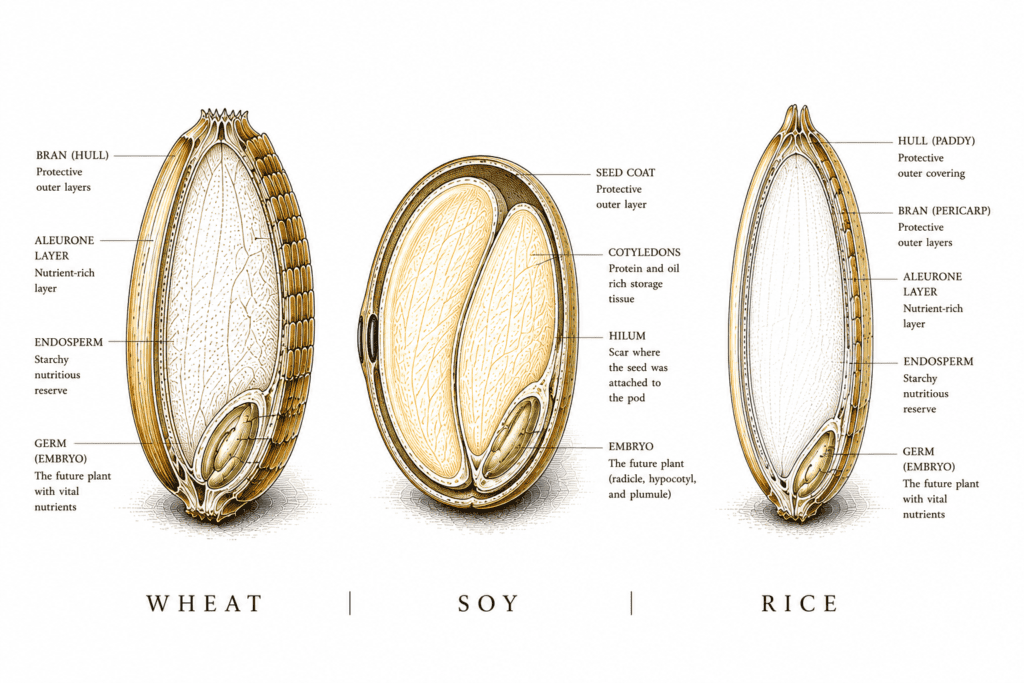
Soft wheat — Elasticity and structure. Contains the proteins that form gluten when hydrated — what makes the dough pliable enough to stretch.
Rice flour — Lightness. It crisps. This is where the shattering exterior comes from.
Soy flour — Protein and strength. This is what lets a dough hold 85% water without collapsing under its own weight.
The proportions are the whole game, and ours are our own. What we’ll say openly is the principle: nothing is in there without a reason. The base is four ingredients and no more — flour, water, yeast and sea salt. No sugar, no seed oils, no preservatives, no dough conditioners.
Why we buy our flour from Italy
Our flours are milled in Italy by Di Marco, at Guidonia Montecelio outside Rome — the company Corrado Di Marco founded, and the source of the original pinsa blend.
Di Marco’s raw materials are certified non-GMO, and both the incoming grain and the finished blend are tested for pesticide residues under a specific monitoring plan built around European Food Safety Authority limits. The flour is not organic-certified, and we will not describe it as though it were.
Eighty-five percent water
Hydration is the ratio of water to flour. Most commercial pizza dough runs near 60%. Neapolitan dough, celebrated for its lightness, sits in roughly the same range.
Ours runs at 85% — 850ml of water for every kilogram of flour. That’s a genuinely difficult dough: slack, sticky, closer to a batter than anything you’d comfortably knead. It takes patience to bring together, and you know it’s ready when a stretched piece goes thin enough to see light through without tearing.
What all that water buys is steam. In the oven it flashes to vapor and blows the interior open into the irregular, honeycombed structure that defines pinsa — airy and open within, thin and crisp without.
Seventy-two hours in the cold
Then we wait. The dough rests at 4–6°C for a minimum of three full days before it’s shaped.
Slowly, over that time, several things happen at once. Acidity rises, lowering the dough’s pH. Yeast works gently, producing carbon dioxide for lift and subtle complexity. And the long, slow enzymatic work develops the faintly tangy, wheaty depth that no fast rise can manufacture.
It’s lighter, and it tends to sit better afterwards — that’s the seventy-two hours of fermentation doing the work before you eat it.
Matteo Zacchino, founder, Vespa Healthy Italian Café
One byproduct deserves its own note. Fermentation produces glutamic acid — the naturally occurring amino acid behind umami, the same compound that makes Parmigiano-Reggiano and San Marzano tomatoes taste the way they do. It is not MSG. MSG is glutamic acid industrially isolated and bonded to sodium. We have never added it and never will; the depth of flavor in our base comes from time, not from a jar.
Then we bake it twice
Pinsa is par-baked before service — a first bake at 320°C (608°F) for about three minutes — then finished with toppings to order.
That first bake does three things. It sets the gluten network, which is where the crispness comes from. It fully gelatinizes the starches, so nothing arrives raw or gummy in the middle. And it denatures the proteins so the base is stable and consistent every time.
Fully cooked starch is also markedly easier for the body to break down than the undercooked center that a very hot, very fast bake can leave behind.
Pinsa vs. pizza, side by side
| Neapolitan pizza | Pinsa romana | |
|---|---|---|
| Flour | Wheat only | Wheat, rice and soy |
| Hydration | ~60% | 85% |
| Fermentation | 4–24 hours | 72 hours, cold |
| Shape | Round, spun | Oval, hand-pressed |
| Crumb | Soft, uniform, chewy | Open, irregular, airy |
| Baking | Single bake, very hot and fast | Par-baked, then finished |
| Afterward | Rich and filling | Light and crisp |
Neither is better. They’re different foods that happen to share a silhouette. If you want soft, foldable, molten-centered pizza, go and eat some excellent Neapolitan. If you want something crisp and light that doesn’t sit heavily afterward, that’s pinsa.
The numbers, from the producer
Di Marco ran the comparison in their own laboratory. These are their figures for their par-baked pinsa base, measured against a pizza base and against white bread, per 100 grams of finished product.
| Pinsa base | Pizza base | White bread | |
|---|---|---|---|
| Calories (kcal) | 230 | 275 | 272 |
| Fat (g) | 2.4 | 6.7 | 3.9 |
| Carbohydrate (g) | 41.0 | 44.1 | 48.4 |
| Protein (g) | 10.2 | 6.7 | 8.5 |
| Salt (g) | 0.5 | 1.8 | 1.3 |
Against a pizza base that is 72% less salt, 64% less fat, 52% more protein and 45 fewer calories. The salt figure is the one that surprises people.
One caveat we would rather state than bury. These are Di Marco’s measurements of Di Marco’s own base. We buy their flour and ferment our own dough here, at eighty-five percent hydration, for seventy-two hours — so the numbers above describe the product family, not the exact pinsa on your plate. The direction is right. The decimal places are theirs, not ours.
Why it tends to feel lighter
Guests tell us this constantly, usually with some surprise. There are straightforward reasons.
- The pH is lower. A more acidic dough is closer to the stomach’s own environment, so less adjustment is needed.
- The starch is fully cooked. Nothing raw or resistant makes it through to ferment further down.
- The structure is open. High hydration means digestive enzymes can penetrate the dough matrix more completely.
We’d rather describe this precisely than sweepingly. “Lighter” is how the food tends to feel — it isn’t a medical claim, and people differ. If you have a diagnosed digestive condition, your doctor knows your situation and a restaurant page doesn’t.
Is pinsa gluten-free?
No. Pinsa is not gluten-free, and it is not safe for anyone with celiac disease.
We want to be completely unambiguous, because it’s asked often and because a vague answer could make someone genuinely unwell.
Our dough is built on soft wheat. Wheat contains gluten. A food must test below 20 parts per million to be labeled gluten-free, and long-fermented wheat dough does not reliably reach that threshold.
The distinction that matters.Celiac disease is an autoimmune condition in which gluten causes real intestinal damage, and even trace amounts are unsafe. If you have celiac disease, we’ll steer you away from the pinsa — no amount of fermentation changes that. Non-celiac gluten sensitivity is a different thing, far more common, and causes discomfort without the autoimmune damage. Many guests in that group tell us they eat our pinsa comfortably when other breads trouble them. That’s the group most likely to notice the difference — but you know your own body, and we’d never tell you otherwise.
Tell us when you order and we’ll give you a straight answer about what’s in the dough and how it’s handled.
How to eat it
Lightly. Pinsa’s architecture is built to stay crisp, and heavy, wet toppings fight it. Roman pinserie keep things restrained: good tomato, good cheese, a few things with real flavor, and room left for the base to be tasted.
Ours run from the plainest to the fully loaded:
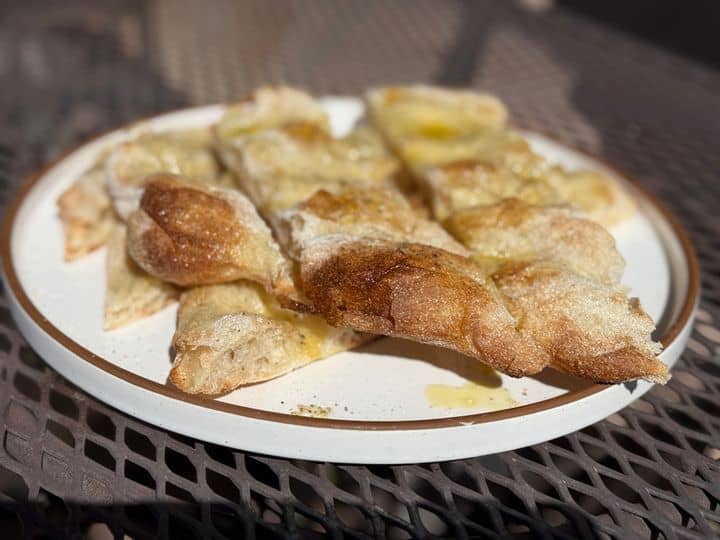
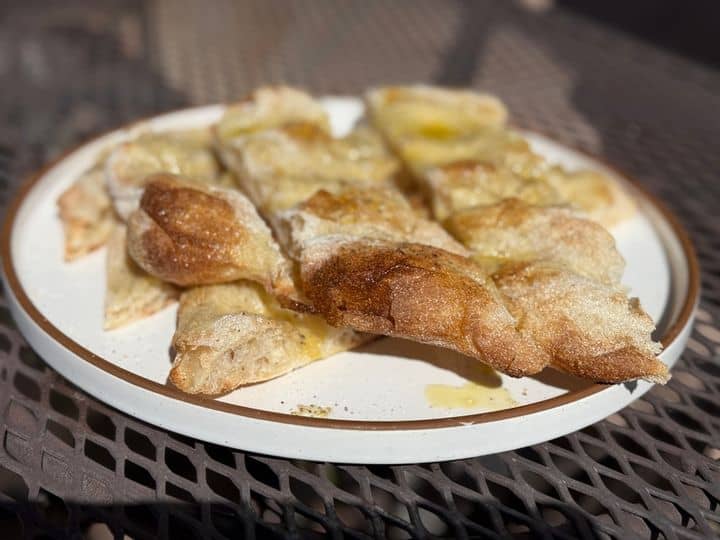
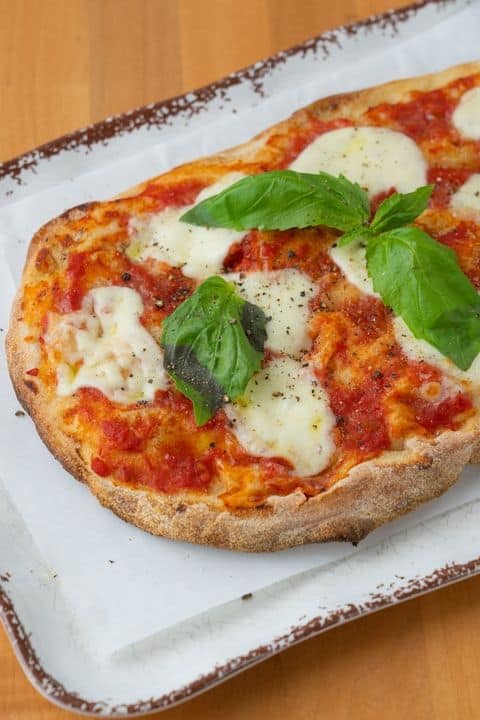
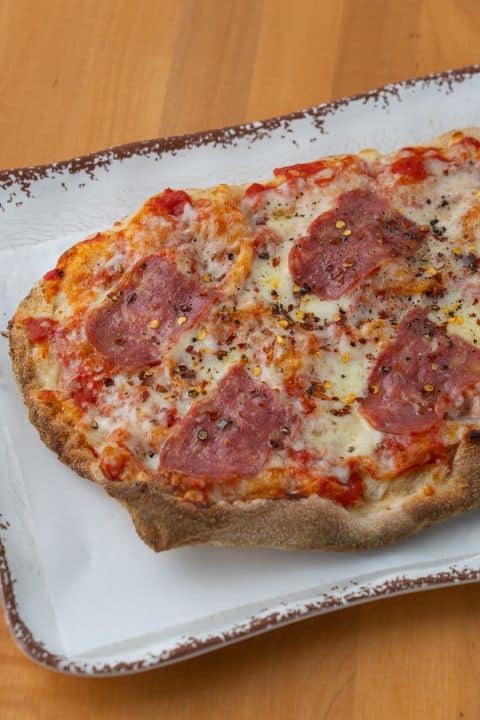
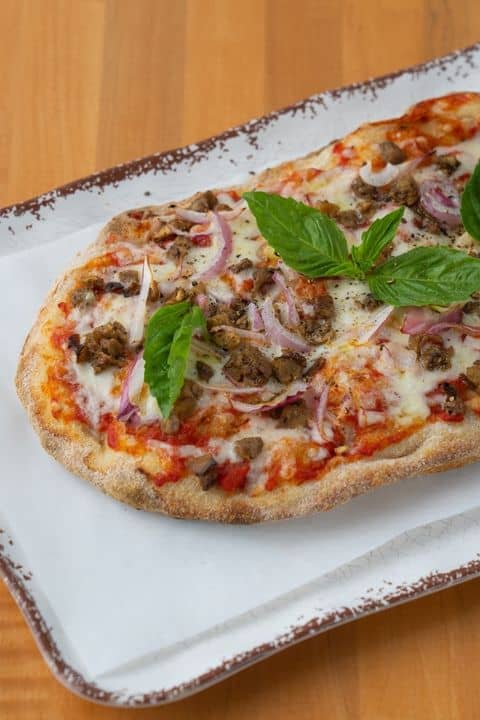
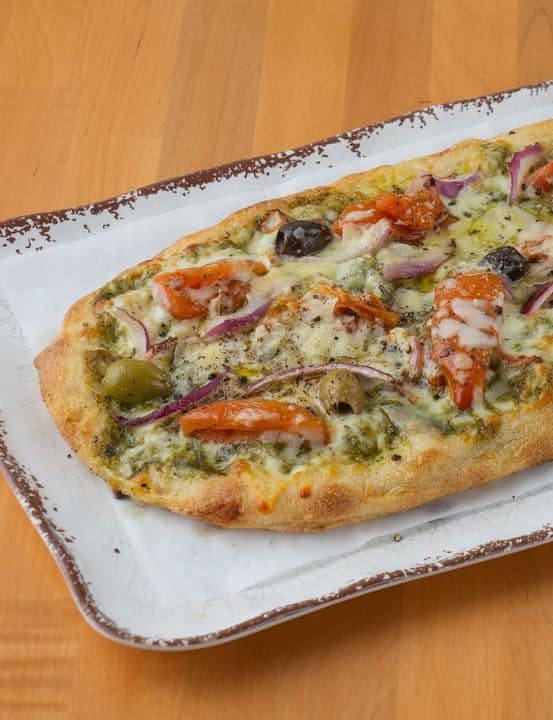
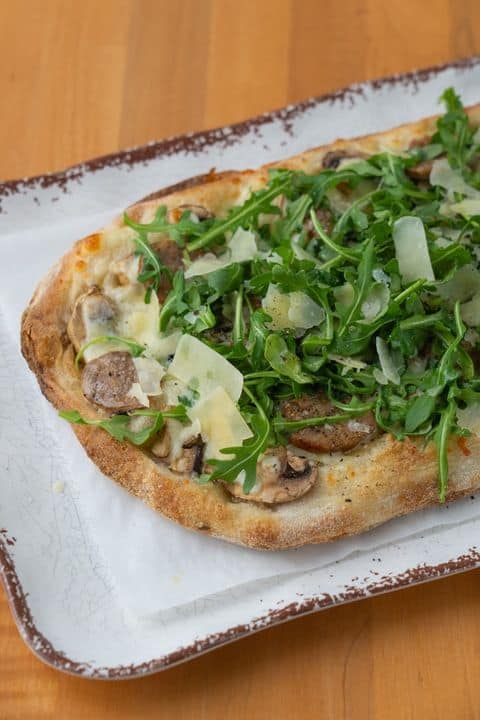
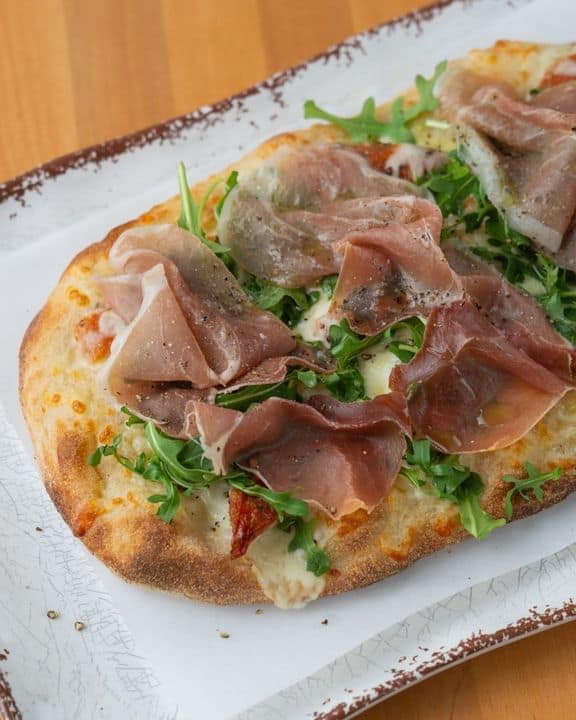
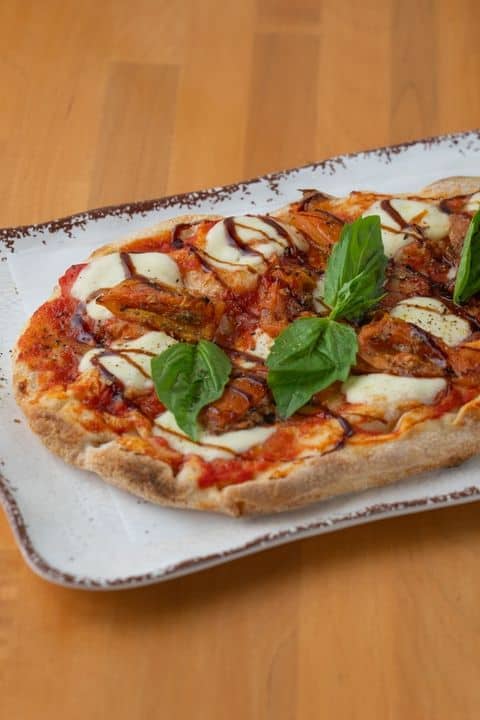
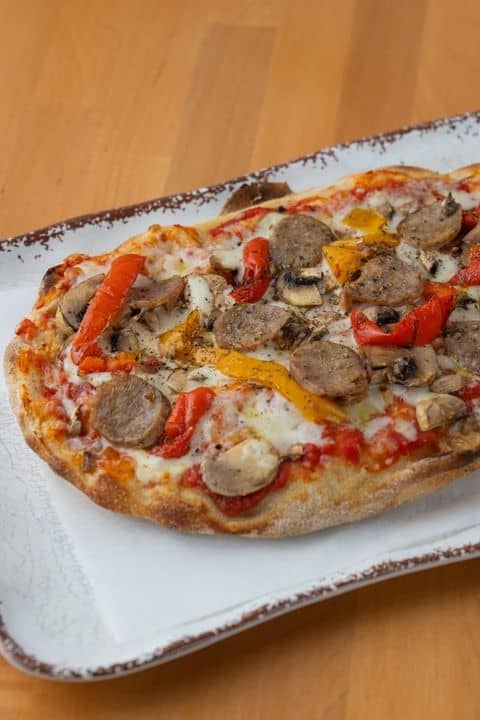
First time? Order the Focaccia or the Margherita. With almost nothing on top there’s nowhere for the dough to hide, and the dough is the entire point.
Why we make it in Sedona
Our family has cooked Italian food professionally since 1998. Matteo grew up in his family’s restaurants before opening Vespa in West Sedona.
Pinsa suits this place. Sedona fills up with people who’ve spent the day on a trail and want dinner that doesn’t flatten them, and with visitors who care where their food comes from. A crisp, light flatbread that takes three days to make is a reasonable answer to both.
The open kitchen is deliberate. You can watch the pinsa go in and come out. We’d rather be the kind of restaurant where nothing needs hiding — which is also, more or less, why this page tells you the real origin story instead of the better-sounding one.
For the broader story behind those choices, see the way we cook it at Vespa.
Common questions
What does “pinsa” mean?
It comes from the Latin pinsere — to press or stretch by hand. The name describes the technique, and it’s genuinely ancient. The modern recipe attached to it is not.
Is pinsa healthier than pizza?
It’s lighter, and it tends to sit better afterwards. Di Marco’s own laboratory figures are in the table above. Whether it’s healthier depends on what you put on it and how much of it you eat — same as everything else.
Is pinsa vegan?
The base is flour, water, yeast and salt, so it contains no animal products. Whether a given pinsa is vegan depends on toppings — ask and we’ll sort it out.
Why is pinsa oval instead of round?
Because it’s pressed and stretched by hand rather than spun or rolled. The oval is simply what the dough does, and it’s the traditional Roman shape.
Does pinsa contain MSG?
Never. The savory depth comes from glutamic acid produced naturally during fermentation — the same amino acid found in Parmigiano and ripe tomatoes. MSG is that compound industrially isolated and bonded to sodium. We don’t use it, or seed oils, or preservatives.
Do you make gluten-free pinsa?
Our pinsa dough contains wheat and is not celiac-safe. Ask us directly about gluten-free options and cross-contact and we’ll give you an accurate answer for your situation rather than a vague one.
Come taste three days of work
Vespa Healthy Italian Café
1350 W State Route 89A, Suite 22, Sedona, AZ 86336
Daily 11am–9pm, until 10pm Friday and Saturday
(928) 862-2228